Download Ebook Collaboration Explained: Facilitation Skills for Software Project Leaders, by Jean Tabaka
Yeah, spending time to check out the publication Collaboration Explained: Facilitation Skills For Software Project Leaders, By Jean Tabaka by online could also give you good session. It will alleviate to correspond in whatever problem. By doing this could be more intriguing to do and also simpler to review. Now, to get this Collaboration Explained: Facilitation Skills For Software Project Leaders, By Jean Tabaka, you can download and install in the link that we supply. It will certainly help you to get easy means to download guide Collaboration Explained: Facilitation Skills For Software Project Leaders, By Jean Tabaka.
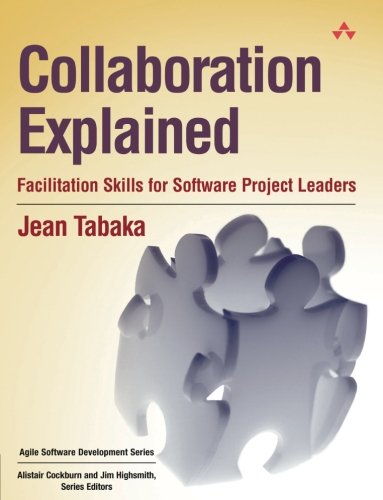
Collaboration Explained: Facilitation Skills for Software Project Leaders, by Jean Tabaka

Download Ebook Collaboration Explained: Facilitation Skills for Software Project Leaders, by Jean Tabaka
Collaboration Explained: Facilitation Skills For Software Project Leaders, By Jean Tabaka. In what case do you like reading a lot? Exactly what about the kind of the book Collaboration Explained: Facilitation Skills For Software Project Leaders, By Jean Tabaka The requirements to check out? Well, everybody has their very own reason why needs to read some books Collaboration Explained: Facilitation Skills For Software Project Leaders, By Jean Tabaka Mostly, it will relate to their necessity to obtain knowledge from guide Collaboration Explained: Facilitation Skills For Software Project Leaders, By Jean Tabaka as well as wish to check out merely to obtain enjoyment. Novels, tale book, and also other enjoyable e-books become so prominent now. Besides, the scientific publications will certainly also be the best need to select, specifically for the students, instructors, doctors, business person, and other professions which enjoy reading.
Right here, we have numerous e-book Collaboration Explained: Facilitation Skills For Software Project Leaders, By Jean Tabaka and also collections to review. We likewise offer variant types as well as sort of guides to look. The enjoyable e-book, fiction, past history, unique, science, and various other kinds of publications are readily available here. As this Collaboration Explained: Facilitation Skills For Software Project Leaders, By Jean Tabaka, it ends up being one of the preferred book Collaboration Explained: Facilitation Skills For Software Project Leaders, By Jean Tabaka collections that we have. This is why you are in the right site to see the remarkable publications to own.
It won't take even more time to purchase this Collaboration Explained: Facilitation Skills For Software Project Leaders, By Jean Tabaka It won't take even more cash to publish this book Collaboration Explained: Facilitation Skills For Software Project Leaders, By Jean Tabaka Nowadays, people have been so wise to make use of the innovation. Why don't you utilize your gadget or various other tool to conserve this downloaded and install soft file e-book Collaboration Explained: Facilitation Skills For Software Project Leaders, By Jean Tabaka In this manner will certainly allow you to constantly be gone along with by this e-book Collaboration Explained: Facilitation Skills For Software Project Leaders, By Jean Tabaka Obviously, it will certainly be the finest close friend if you review this publication Collaboration Explained: Facilitation Skills For Software Project Leaders, By Jean Tabaka until finished.
Be the initial to get this publication now as well as obtain all reasons you have to review this Collaboration Explained: Facilitation Skills For Software Project Leaders, By Jean Tabaka The publication Collaboration Explained: Facilitation Skills For Software Project Leaders, By Jean Tabaka is not only for your tasks or requirement in your life. E-books will certainly consistently be a buddy in each time you check out. Now, allow the others learn about this web page. You could take the advantages as well as share it likewise for your buddies as well as individuals around you. By in this manner, you could truly get the significance of this publication Collaboration Explained: Facilitation Skills For Software Project Leaders, By Jean Tabaka beneficially. Just what do you believe concerning our idea here?
“Collaboration Explained is a deeply pragmatic book that helps agile practitioners understand and manage complex organizational and team dynamics. As an agile coach, I’ve found the combination of straightforward advice and colorful anecdotes to be invaluable in guiding and focusing interactions with my teams. Jean’s wealth of experience is conveyed in a carefully struck balance of reference guides and prose, facilitating just-in-time learning in the agile spirit. All in all, a superb resource for building stronger teams that’s fit for agile veterans and neophytes alike.”
—Arlen Bankston, Lean Agile Practice Manager, CC Pace
“If Agile is the new ‘what,’ then surely Collaboration is the new ‘how.’ There are many things I really like about Jean’s new book. Right at the top of the list is that I don’t have to make lists of ideas for collaboration and facilitation anymore. Jean has it all. Not only does she have those great ideas for meetings, retrospectives, and team decision-making that I need to remember, but the startling new and thought-provoking ideas are there too. And the stories, the stories, the stories! The best way to transfer wisdom. Thanks, Jean!”
—Linda Rising, Independent Consultant
The Hands-On Guide to Effective Collaboration in Agile Projects
To succeed, an agile project demands outstanding collaboration among all its stakeholders. But great collaboration doesn’t happen by itself; it must be carefully planned and facilitated throughout the entire project lifecycle. Collaboration Explained is the first book to bring together proven, start-to-finish techniques for ensuring effective collaboration in any agile software project.
Since the early days of the agile movement, Jean Tabaka has been studying and promoting collaboration in agile environments. Drawing on her unsurpassed experience, she offers clear guidelines and easy-to-use collaboration templates for every significant project event: from iteration and release planning, through project chartering, all the way through post-project retrospectives.
Tabaka’s hands-on techniques are applicable to every leading agile methodology, from Extreme Programming and Scrum to Crystal Clear. Above all, they are practical: grounded in a powerful understanding of the technical, business, and human challenges you face as a project manager or development team member.
· Build collaborative software development cultures, leaders, and teams
· Prepare yourself to collaborate—and prepare your team
· Define clear roles for each participant in promoting collaboration
· Set your collaborative agenda
· Master tools for organizing collaboration more efficiently
· Run effective collaborative meetings—including brainstorming sessions
· Promote better small-group and pair-programming collaboration
· Get better information, and use it to make better decisions
· Use non-abusive conflict to drive positive outcomes
· Collaborate to estimate projects and schedules more accurately
· Strengthen collaboration across distributed, virtual teams
· Extend collaboration from individual projects to the entire development organization
- Sales Rank: #518989 in Books
- Published on: 2006-01-16
- Released on: 2006-01-06
- Ingredients: Example Ingredients
- Original language: English
- Number of items: 1
- Dimensions: 9.00" h x 1.20" w x 7.00" l, 1.41 pounds
- Binding: Paperback
- 456 pages
From the Back Cover
“Collaboration Explained is a deeply pragmatic book that helps agile practitioners understand and manage complex organizational and team dynamics. As an agile coach, I’ve found the combination of straightforward advice and colorful anecdotes to be invaluable in guiding and focusing interactions with my teams. Jean’s wealth of experience is conveyed in a carefully struck balance of reference guides and prose, facilitating just-in-time learning in the agile spirit. All in all, a superb resource for building stronger teams that’s fit for agile veterans and neophytes alike.”
–Arlen Bankston, Lean Agile Practice Manager, CC Pace
“If Agile is the new ‘what,’ then surely Collaboration is the new ‘how.’ There are many things I really like about Jean’s new book. Right at the top of the list is that I don’t have to make lists of ideas for collaboration and facilitation anymore. Jean has it all. Not only does she have those great ideas for meetings, retrospectives, and team decision-making that I need to remember, but the startling new and thought-provoking ideas are there too. And the stories, the stories, the stories! The best way to transfer wisdom. Thanks, Jean!”
–Linda Rising, Independent Consultant
The Hands-On Guide to Effective Collaboration in Agile Projects
To succeed, an agile project demands outstanding collaboration among all its stakeholders. But great collaboration doesn’t happen by itself; it must be carefully planned and facilitated throughout the entire project lifecycle. Collaboration Explained is the first book to bring together proven, start-to-finish techniques for ensuring effective collaboration in any agile software project.
Since the early days of the agile movement, Jean Tabaka has been studying and promoting collaboration in agile environments. Drawing on her unsurpassed experience, she offers clear guidelines and easy-to-use collaboration templates for every significant project event: from iteration and release planning, through project chartering, all the way through post-project retrospectives.
Tabaka’s hands-on techniques are applicable to every leading agile methodology, from Extreme Programming and Scrum to Crystal Clear. Above all, they are practical: grounded in a powerful understanding of the technical, business, and human challenges you face as a project manager or development team member.
· Build collaborative software development cultures, leaders, and teams
· Prepare yourself to collaborate–and prepare your team
· Define clear roles for each participant in promoting collaboration
· Set your collaborative agenda
· Master tools for organizing collaboration more efficiently
· Run effective collaborative meetings–including brainstorming sessions
· Promote better small-group and pair-programming collaboration
· Get better information, and use it to make better decisions
· Use non-abusive conflict to drive positive outcomes
· Collaborate to estimate projects and schedules more accurately
· Strengthen collaboration across distributed, virtual teams
· Extend collaboration from individual projects to the entire development organization
© Copyright Pearson Education. All rights reserved.
About the Author
Jean Tabaka is an Agile Coach with Rally Software Development, specializing in creating, coaching, and mentoring collaborative, agile software teams. Jean brings over 25 years of experience in software development to the agile plate in a variety of organizational contexts including internal IT departments, ISVs, government agencies, and consulting organizations. Having implemented both plan-driven and agile development approaches for Sybase, Siebel Systems, and Qwest, as well as a variety of smaller ventures, her work has spanned industries and continents. As an agile mentor, Jean coaches software teams through training and facilitation to adopt agile principles and practices using a hybrid of the leading agile methods. With a passion for collaboration practices through facilitation techniques, she guides organizations in creating high-performance teams. She is the co-author of Physical Database Design for Sybase SQL Server (Prentice Hall, 1995) and is a frequent lecturer and contributor on the topic of collaboration practices in agile teams. A Certified ScrumMaster, as well as Certified ScrumMaster Trainer, and Certified Professional Facilitator, she holds a Master of Arts from Michigan State University and a Master of Computer Science from Johns Hopkins University.
© Copyright Pearson Education. All rights reserved.
Excerpt. © Reprinted by permission. All rights reserved.
Preface Preface A Path of Learning
When I started my career in IT back in the 1970s, I began as an intern for a JCL helpdesk that supported a team of analysts who expected their programs to run smoothly (enough) in the massive farm of IBM 3270s built for that purpose. I never met the analysts I supported; I never really knew the business they were supporting. I just knew that a stream of data from one system through tape drives to another system had not completed correctly (ABEND!) and I needed to restart the job or redirect the stream from box to box as needed.
The only "collaboration" I experienced was in the form of directions from my supervisor when I didn't know how to solve the problem. There were no team meetings, no team decisions (except about the smoking policy that encouraged cigarettes but banned cigars), and no sense of team ownership of success. Each of the other members of the "team" had their separate set of analysts they supported, their own stacks of punch card carriers, and their personal, safeguarded mag tapes they used to manage their work.
In subsequent jobs, I moved into other 3GL environments, still working largely without access to a customer or other developers. With regard to the development teams, the work was divided up by our manager who made decisions about what we should be doing, how it should be done, and when it should be completed. Our team meetings were weekly bug report meetings where our manager would prioritize what needed to be done and its due date. We passed work from one job title to another (analyst, to designer, to developer, to tester), and teamwork for me was largely restricted to one-on-one debugging sessions with another developer. But a change was beginning to unfold about how software development projects, their teams, and their managers could work more effectively.
I first dipped into the notion of a learning-oriented approach to software development via Wicked Problems, Righteous Solutions by Peter DeGrace and Leslie Hulet-Stahl (Prentice Hall, 1998). The book became my bible about what was wrong with phase-driven, waterfall approaches and what might be right about a more empirically motivated approach. My next epiphany came in the late 1990s with a visit to the UK where I learned of a new methodology being adopted in Europe: the Dynamic Systems Development Method, or DSDM. What was startling for me about this methodology at the time was its emphasis on timeboxes versus scope for software delivery. It turned my notion of software development methodology on its ear. Moreover, as documentation was de-emphasized, rapid effective face-to-face communication was explicitly built into the approach through its facilitated workshops.
At this point, I made a conscious decision to steer my methodology focus toward facilitation practices that I could apply to software development teams. Because I had seen too many examples of how teams can crumble in bad meeting contexts and in bad control environments, I wanted to learn ways to make all the various team collaborations more reliable, more frequent, faster, and more productive. I took classes in facilitation, read books on facilitation, and attended facilitation conferences. I became a certified professional facilitator, and I began to teach facilitation as well as apply it.
And I learned a few things: facilitation has a place in how we create teams and coax collaborative work from and for them. Additionally, I learned that facilitation is not about control or manipulation. Rather, it is about applying tools, techniques, and processes in support of teams eager to engage in high performance. Good facilitators listen and echo in a way that helps a team hear itself and apply its best wisdom. Project managers and software team leads with facilitative skills become leaders who can listen and echo as they lead teams in vision and success.
Today, I find myself in teams that create a common goal, work to communicate frequently, and make decisions based on their collective wisdom. The agile methodologies we now consult (Scrum, Extreme Programming, Crystal Clear, Feature Driven Development, and Lean Software Development) emphasize project success through disciplines of engineering and communications that can effectively respond to change. In these contexts, I recognize the stabilizing force of collaboration and communication as fundamental practices in project success. Projects need teams; teams need communication. And while communication comes in a variety of forms from one-on-one to very large groups, at the team level of three or more people making decisions and acting on them, communication relies on collaboration.
This book brings together my specific lessons about the importance of applying collaboration in teams. Specifically, it catalogues the practices of facilitation I have learned to use in order to liberate teams into a variety of information gathering and decision modes that promote high performance. I have come to rely on facilitation not as a manipulation or control technique, but rather as a way to encourage participatory decision making among teams of experts. For me, facilitation, more than any other leadership or team practice, has proven to be my greatest gift to teams in creating a vision for them and encouraging their best teamwork.
A number of colleagues have warned me about negative experiences they've endured where a facilitator has used his role in a meeting to manipulate and control the team. That is not my intent here. I believe in leaders who engage facilitatively in service to the team, not in control of it. I believe in teams who recognize the wisdom of a powerful leader and how such a leader's move through various decision approaches strengthens them. A good leader absorbs a rich set of tools in creating success with and for their teams. In this guidebook, I offer one subset of those tools, the facilitation tools.
© Copyright Pearson Education. All rights reserved.
Most helpful customer reviews
0 of 0 people found the following review helpful.
Five Stars
By Myrtle
Full of actual and practical knowledge that fills in the gap between fluff and actually getting stuff done.
0 of 0 people found the following review helpful.
Fast excellent service
By Kindle Customer
This was fast, excellent service. Received the item a lot quicker than I expected and it was in perfect shape.
0 of 0 people found the following review helpful.
Fantastic for Collaboration and Consensus building
By Avid Reader Man
This book stands out as one of my favorites on how to really build collaborative teams, and to build consensus. It is full of real-world examples and specific techniques. This is a hard topic to tackle, and I believe that the authors write from experience.
The techniques in this book are not just for "Agile" project managers. They can be applied to many different teams on how to facilitate and develop collaboration in meetings, better decisions through consensus, and generally gain team commitment.
Collaboration Explained: Facilitation Skills for Software Project Leaders, by Jean Tabaka PDF
Collaboration Explained: Facilitation Skills for Software Project Leaders, by Jean Tabaka EPub
Collaboration Explained: Facilitation Skills for Software Project Leaders, by Jean Tabaka Doc
Collaboration Explained: Facilitation Skills for Software Project Leaders, by Jean Tabaka iBooks
Collaboration Explained: Facilitation Skills for Software Project Leaders, by Jean Tabaka rtf
Collaboration Explained: Facilitation Skills for Software Project Leaders, by Jean Tabaka Mobipocket
Collaboration Explained: Facilitation Skills for Software Project Leaders, by Jean Tabaka Kindle

Tidak ada komentar:
Posting Komentar