Download PDF Hooked: How to Build Habit-Forming Products, by Nir Eyal
Hooked: How To Build Habit-Forming Products, By Nir Eyal How a basic suggestion by reading can improve you to be a successful person? Reading Hooked: How To Build Habit-Forming Products, By Nir Eyal is a really straightforward task. But, just how can many people be so lazy to read? They will prefer to invest their downtime to chatting or hanging around. When actually, checking out Hooked: How To Build Habit-Forming Products, By Nir Eyal will certainly give you much more opportunities to be successful finished with the hard works.
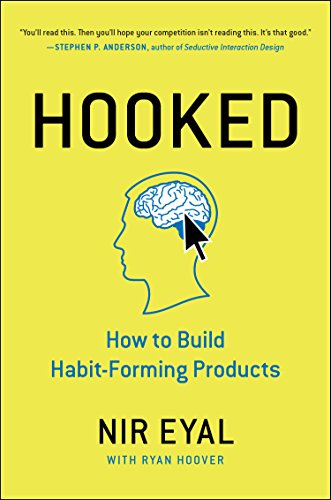
Hooked: How to Build Habit-Forming Products, by Nir Eyal

Download PDF Hooked: How to Build Habit-Forming Products, by Nir Eyal
Book lovers, when you require a brand-new book to review, locate guide Hooked: How To Build Habit-Forming Products, By Nir Eyal below. Never worry not to find exactly what you require. Is the Hooked: How To Build Habit-Forming Products, By Nir Eyal your required book now? That holds true; you are actually a good viewers. This is a perfect book Hooked: How To Build Habit-Forming Products, By Nir Eyal that comes from terrific writer to show you. The book Hooked: How To Build Habit-Forming Products, By Nir Eyal offers the best experience and lesson to take, not only take, however likewise find out.
The perks to consider reading the books Hooked: How To Build Habit-Forming Products, By Nir Eyal are coming to improve your life top quality. The life top quality will certainly not only concerning just how much understanding you will certainly acquire. Even you review the enjoyable or entertaining e-books, it will aid you to have enhancing life high quality. Feeling enjoyable will certainly lead you to do something perfectly. Furthermore, the publication Hooked: How To Build Habit-Forming Products, By Nir Eyal will offer you the driving lesson to take as a great need to do something. You might not be pointless when reviewing this e-book Hooked: How To Build Habit-Forming Products, By Nir Eyal
Never mind if you don't have adequate time to head to the e-book shop as well as search for the favourite publication to read. Nowadays, the on-line publication Hooked: How To Build Habit-Forming Products, By Nir Eyal is concerning provide ease of reading routine. You may not have to go outdoors to search guide Hooked: How To Build Habit-Forming Products, By Nir Eyal Searching as well as downloading and install guide qualify Hooked: How To Build Habit-Forming Products, By Nir Eyal in this post will certainly offer you better option. Yeah, on-line e-book Hooked: How To Build Habit-Forming Products, By Nir Eyal is a kind of electronic e-book that you can enter the web link download given.
Why should be this on the internet book Hooked: How To Build Habit-Forming Products, By Nir Eyal You might not require to go someplace to review the e-books. You could read this book Hooked: How To Build Habit-Forming Products, By Nir Eyal each time and every where you want. Also it remains in our extra time or sensation bored of the works in the office, this corrects for you. Get this Hooked: How To Build Habit-Forming Products, By Nir Eyal now and be the quickest individual which completes reading this book Hooked: How To Build Habit-Forming Products, By Nir Eyal
How do successful companies create products people can't put down?
Why do some products capture widespread attention while others flop? What makes us engage with certain products�out of sheer habit? Is there a pattern underlying how technologies hook us?
Nir Eyal answers these questions (and many more) by explaining the "Hook Model" -- a four steps process embedded� into the products of many successful companies to subtly encourage customer behavior. Through consecutive “hook� cycles,” these products reach their ultimate goal of bringing users back over and over again, without depending on� costly advertising or aggressive messaging.
Hooked is based on Eyal’s years of research, consulting, and practical experience. He wrote the book he wished had� been available to him as a startup founder – not abstract theory, but a how-to guide for building better products.� Hooked is written for product managers, designers, marketers, startup founders, and anyone who seeks to understand� how products influence our behavior.
Eyal provides readers with:
- Practical insights to create user habits that stick.
- Actionable steps for building products people love.
- Fascinating examples from the iPhone to Twitter, Pinterest to the Bible App, and many other habit-forming products.
- Sales Rank: #2399528 in Books
- Published on: 2014-11-04
- Released on: 2014-11-04
- Format: International Edition
- Number of items: 1
- Dimensions: 8.50" h x 1.20" w x 5.70" l,
- Binding: Hardcover
- 256 pages
Review
"A must-read for everyone who cares about driving customer engagement." - Eric Ries, author of The Lean Startup
"Hooked gives you the blueprint for the next generation of products. Read Hooked or the company that replaces you will." - Matt Mullenweg, founder of WordPress
"The book everyone in Silicon Valley is talking about." - Stephen P. Anderson, author of Seductive Interaction Design
"The most high bandwidth, high octane, and valuable presentation I have ever seen on this subject." - Rory Sutherland, vice chairman, Oglivy & Mather
"Nir's work is an essential crib sheet for any start-up looking to understand user psychology." - Dave McClure, founder of 500 Startups
"When it comes to driving engagement and building habits, Hooked is an excellent guide into the mind of the user." - Andrew Chen, technology writer and investor
"I've learned a great deal from Nir, and you will too. He'll help you design habits to benefit your users, and your company." - Dr. Stephen Wendel, author of Designing for Behavior Change
"With concrete advice and tales from the product-development trenches, this is a thoughtful discussion of how to create something that users never knew they couldn’t live without." - Publishers Weekly
About the Author
�RYAN HOOVER's writing has appeared in TechCrunch, The Next Web, Forbes and Fast Company. After working on Hooked with Nir Eyal, Hoover founded Product Hunt, a company that has been described as "the place to discover the enxt big things in tech."
Excerpt. � Reprinted by permission. All rights reserved.
contents
introduction
Seventy-nine percent of smartphone owners check their device within fifteen minutes of waking up every morning.1 Perhaps more startling, fully one-third of Americans say they would rather give up sex than lose their cell phones.2
A 2011 university study suggested people check their phones thirty-four times per day.3 However, industry insiders believe that number is closer to an astounding 150 daily sessions.4
Face it: We’re hooked.
The technologies we use have turned into compulsions, if not full-fledged addictions. It’s the impulse to check a message notification. It’s the pull to visit YouTube, Facebook, or Twitter for just a few minutes, only to find yourself still tapping and scrolling an hour later. It’s the urge you likely feel throughout your day but hardly notice.
Cognitive psychologists define habits as “automatic behaviors triggered by situational cues”: things we do with little or no conscious thought.5 The products and services we use habitually alter our everyday behavior, just as their designers intended.6 Our actions have been engineered.
How do companies, producing little more than bits of code displayed on a screen, seemingly control users’ minds? What makes some products so habit forming?
Forming habits is imperative for the survival of many products. As infinite distractions compete for our attention, companies are learning to master novel tactics to stay relevant in users’ minds. Amassing millions of users is no longer good enough. Companies increasingly find that their economic value is a function of the strength of the habits they create. In order to win the loyalty of their users and create a product that’s regularly used, companies must learn not only what compels users to click but also what makes them tick.
Although some companies are just waking up to this new reality, others are already cashing in. By mastering habit-forming product design, the companies profiled in this book make their goods indispensable.
FIRST TO MIND WINS
Companies that form strong user habits enjoy several benefits to their bottom line. These companies attach their product to internal triggers. As a result, users show up without any external prompting.
Instead of relying on expensive marketing, habit-forming companies link their services to the users’ daily routines and emotions.7 A habit is at work when users feel a tad bored and instantly open Twitter. They feel a pang of loneliness and before rational thought occurs, they are scrolling through their Facebook feeds. A question comes to mind and before searching their brains, they query Google. The first-to-mind solution wins. In chapter 1 of this book, we explore the competitive advantages of habit-forming products.
How do products create habits? The answer: They manufacture them. While fans of the television show Mad Men are familiar with how the ad industry once created consumer desire during Madison Avenue’s golden era, those days are long gone. A multiscreen world of ad-wary consumers has rendered Don Draper’s big-budget brainwashing useless to all but the biggest brands.
Today, small start-up teams can profoundly change behavior by guiding users through a series of experiences I call hooks. The more often users run through these hooks, the more likely they are to form habits.
How I Got Hooked
In 2008 I was among a team of Stanford MBAs starting a company backed by some of the brightest investors in Silicon Valley. Our mission was to build a platform for placing advertising into the booming world of online social games.
Notable companies were making hundreds of millions of dollars selling virtual cows on digital farms while advertisers were spending huge sums of money to influence people to buy whatever they were peddling. I admit I didn’t get it at first and found myself standing at the water’s edge wondering, “How do they do it?”
At the intersection of these two industries dependent on mind manipulation, I embarked upon a journey to learn how products change our actions and, at times, create compulsions. How did these companies engineer user behavior? What were the moral implications of building potentially addictive products? Most important, could the same forces that made these experiences so compelling also be used to build products to improve people’s lives?
Where could I find the blueprints for forming habits? To my disappointment, I found no guide. Businesses skilled in behavior design guarded their secrets, and although I uncovered books, white papers, and blog posts tangentially related to the topic, there was no how-to manual for building habit-forming products.
I began documenting my observations of hundreds of companies to uncover patterns in user-experience designs and functionality. Although every business had its unique flavor, I sought to identify the commonalities behind the winners and understand what was missing among the losers.
I looked for insights from academia, drawing upon consumer psychology, human-computer interaction, and behavioral economics research. In 2011 I began sharing what I learned and started working as a consultant to a host of Silicon Valley companies, from small start-ups to Fortune 500 enterprises. Each client provided an opportunity to test my theories, draw new insights, and refine my thinking. I began blogging about what I learned at NirAndFar.com, and my essays were syndicated to other sites. Readers soon began writing in with their own observations and examples.
In the fall of 2012 Dr. Baba Shiv and I designed and taught a class at the Stanford Graduate School of Business on the science of influencing human behavior. The next year, I partnered with Dr. Steph Habif to teach a similar course at the Hasso Plattner Institute of Design.
These years of distilled research and real-world experience resulted in the creation of the Hook Model: a four-phase process companies use to forms habits.
Through consecutive Hook cycles, successful products reach their ultimate goal of unprompted user engagement, bringing users back repeatedly, without depending on costly advertising or aggressive messaging.
While I draw many examples from technology companies given my industry background, hooks are everywhere—in apps, sports, movies, games, and even our jobs. Hooks can be found in virtually any experience that burrows into our minds (and often our wallets). The four steps of the Hook Model provide the framework for the chapters of this book.
The Hook Model
1. Trigger
A trigger is the actuator of behavior—the spark plug in the engine. Triggers come in two types: external and internal.8 Habit-forming products start by alerting users with external triggers like an e-mail, a Web site link, or the app icon on a phone.
For example, suppose Barbra, a young woman in Pennsylvania, happens to see a photo in her Facebook News Feed taken by a family member from a rural part of the state. It’s a lovely picture and because she is planning a trip there with her brother Johnny, the external trigger’s call to action (in marketing and advertising lingo) intrigues her and she clicks. By cycling through successive hooks, users begin to form associations with internal triggers, which attach to existing behaviors and emotions.
When users start to automatically cue their next behavior, the new habit becomes part of their everyday routine. Over time, Barbra associates Facebook with her need for social connection. Chapter 2 explores external and internal triggers, answering the question of how product designers determine which triggers are most effective.
2. Action
Following the trigger comes the action: the behavior done in anticipation of a reward. The simple action of clicking on the interesting picture in her news feed takes Barbra to a Web site called Pinterest, a “social bookmarking site with a virtual pinboard.”9
This phase of the Hook, as described in chapter 3, draws upon the art and science of usability design to reveal how products drive specific user actions. Companies leverage two basic pulleys of human behavior to increase the likelihood of an action occurring: the ease of performing an action and the psychological motivation to do it.10
Once Barbra completes the simple action of clicking on the photo, she is dazzled by what she sees next.
3. Variable Reward
What distinguishes the Hook Model from a plain vanilla feedback loop is the Hook’s ability to create a craving. Feedback loops are all around us, but predictable ones don’t create desire. The unsurprising response of your fridge light turning on when you open the door doesn’t drive you to keep opening it again and again. However, add some variability to the mix—suppose a different treat magically appears in your fridge every time you open it—and voil�, intrigue is created.
Variable rewards are one of the most powerful tools companies implement to hook users; chapter 4 explains them in further detail. Research shows that levels of the neurotransmitter dopamine surge when the brain is expecting a reward.11 Introducing variability multiplies the effect, creating a focused state, which suppresses the areas of the brain associated with judgment and reason while activating the parts associated with wanting and desire.12 Although classic examples include slot machines and lotteries, variable rewards are prevalent in many other habit-forming products.
When Barbra lands on Pinterest, not only does she see the image she intended to find, but she is also served a multitude of other glittering objects. The images are related to what she is generally interested in—namely things to see on her upcoming trip to rural Pennsylvania—but there are other things that catch her eye as well. The exciting juxtaposition of relevant and irrelevant, tantalizing and plain, beautiful and common, sets her brain’s dopamine system aflutter with the promise of reward. Now she’s spending more time on Pinterest, hunting for the next wonderful thing to find. Before she knows it, she’s spent forty-five minutes scrolling.
Chapter 4 also explores why some people eventually lose their taste for certain experiences and how variability impacts their retention.
4. Investment
The last phase of the Hook Model is where the user does a bit of work. The investment phase increases the odds that the user will make another pass through the Hook cycle in the future. The investment occurs when the user puts something into the product of service such as time, data, effort, social capital, or money.
However, the investment phase isn’t about users opening up their wallets and moving on with their day. Rather, the investment implies an action that improves the service for the next go-around. Inviting friends, stating preferences, building virtual assets, and learning to use new features are all investments users make to improve their experience. These commitments can be leveraged to make the trigger more engaging, the action easier, and the reward more exciting with every pass through the Hook cycle. Chapter 5 delves into how investments encourage users to cycle through successive hooks.
As Barbra enjoys endlessly scrolling through the Pinterest cornucopia, she builds a desire to keep the things that delight her. By collecting items, she gives the site data about her preferences. Soon she will follow, pin, repin, and make other investments, which serve to increase her ties to the site and prime her for future loops through the Hook.
A New Superpower
Habit-forming technology is already here, and it is being used to mold our lives. The fact that we have greater access to the web through our various connected devices—smartphones and tablets, televisions, game consoles, and wearable technology—gives companies far greater ability to affect our behavior.
As companies combine their increased connectivity to consumers, with the ability to collect, mine, and process customer data at faster speeds, we are faced with a future where everything becomes potentially more habit forming. As famed Silicon Valley investor Paul Graham writes, “Unless the forms of technological progress that produced these things are subject to different laws than technological progress in general, the world will get more addictive in the next 40 years than it did in the last 40.”13 Chapter 6 explores this new reality and discusses the morality of manipulation.
Recently, a blog reader e-mailed me, “If it can’t be used for evil, it’s not a superpower.” He’s right. And under this definition, building habit-forming products is indeed a superpower. If used irresponsibly, bad habits can quickly degenerate into mindless, zombielike addictions.
Did you recognize Barbra and her brother Johnny from the previous example? Zombie film buffs likely did. They are characters from the classic horror flick Night of the Living Dead, a story about people possessed by a mysterious force, which compels their every action.14
No doubt you’ve noticed the resurgence of the zombie genre over the past several years. Games like Resident Evil, television shows like The Walking Dead, and movies including World War Z are a testament to the creatures’ growing appeal. But why are zombies suddenly so fascinating? Perhaps technology’s unstoppable progress—ever more pervasive and persuasive—has grabbed us in a fearful malaise at the thought of being involuntarily controlled.
Although the fear is palpable, we are like the heroes in every zombie film—threatened but ultimately more powerful. I have come to learn that habit-forming products can do far more good than harm. Choice architecture, a concept described by famed scholars Thaler, Sunstein, and Balz in their same-titled scholarly paper, offers techniques to influence people’s decisions and affect behavioral outcomes. Ultimately, though, the practice should be “used to help nudge people to make better choices (as judged by themselves).”15 Accordingly, this book teaches innovators how to build products to help people do the things they already want to do but, for lack of a solution, don’t do.
Hooked seeks to unleash the tremendous new powers innovators and entrepreneurs have to influence the everyday lives of billions of people. I believe the trinity of access, data, and speed presents unprecedented opportunities to create positive habits.
When harnessed correctly, technology can enhance lives through healthful behaviors that improve our relationships, make us smarter, and increase productivity.
The Hook Model explains the rationale behind the design of many successful habit-forming products and services we use daily. Although not exhaustive given the vast amount of academic literature available, the model is intended to be a practical tool (rather than a theoretical one) made for entrepreneurs and innovators who aim to use habits for good. In this book I have compiled the most relevant research, shared actionable insights, and provided a practical framework designed to increase the innovator’s odds of success.
Hooks connect the user’s problem with a company’s solution frequently enough to form a habit. My goal is to provide you with a deeper understanding of how certain products change what we do and, by extension, who we are.
HOW TO USE THIS BOOK
At the end of each section, you’ll find a few bulleted takeaways. Reviewing them, jotting them down in a notebook, or sharing them on a social network is a great way to pause, reflect, and reinforce what you have read.
Building a habit-forming product yourself? If so, the “Do This Now” sections at the end of subsequent chapters will help guide your next steps.
REMEMBER & SHARE
���•�Habits are defined as “behaviors done with little or no conscious thought.”
���•�The convergence of access, data, and speed is making the world a more habit-forming place.
���•�Businesses that create customer habits gain a significant competitive advantage.
���•�The Hook Model describes an experience designed to connect the user’s problem to a solution frequently enough to form a habit.
���•�The Hook Model has four phases: trigger, action, variable reward, and investment.
1
The Habit Zone
When I run, I zone out. I don’t think about what my body is doing and my mind usually wanders elsewhere. I find it relaxing and refreshing, and run about three mornings each week. Recently, I needed to take an overseas client call during my usual morning run time. “No biggie,” I thought. “I can run in the evening instead.” However, the time shift created some peculiar behaviors that night.
I left the house for my run at dusk and as I was about to pass a woman taking out her trash, she made eye contact and smiled. I politely saluted her with “Good morning!” and then caught my mistake: “I mean, good evening! Sorry!” I corrected myself, realizing I was about ten hours off. She furrowed her brow and cracked a nervous smile.
Slightly embarrassed, I noted how my mind had been oblivious to the time of day. I chided myself not to do it again, but within a few minutes I passed another runner and again—as if possessed—I blurted out, “Good morning!” What was going on?
Back home, during my normal post-run shower, my mind began to wander again as it often does when I bathe. My brain’s autopilot switch turned on and I proceeded with my daily routine, unaware of my actions.
It wasn’t until I felt the nick of the razor cutting my face that I realized I had lathered up and started shaving. Although it is something I do every morning, shaving was painfully unnecessary in the evening. And yet I’d done it anyway, unknowingly.
The evening version of my morning run had triggered a behavioral script that instructed my body to carry out my usual run-related activities—all without mindful awareness. Such is the nature of ingrained habits—behaviors done with little or no conscious thought—which, by some estimates, guide nearly half of our daily actions.1
Habits are one of the ways the brain learns complex behaviors. Neuroscientists believe habits give us the ability to focus our attention on other things by storing automatic responses in the basal ganglia, an area of the brain associated with involuntary actions.2
Habits form when the brain takes a shortcut and stops actively deliberating over what to do next.3 The brain quickly learns to codify behaviors that provide a solution to whatever situation it encounters.
Most helpful customer reviews
152 of 157 people found the following review helpful.
This is the absolute best book on product development I've ever read
By J. Walnes
If you're trying to build the next big app, you need user engagement. This book lays down a model building engagement by having users constantly return to your app. In the beginning this is prompted, but eventually it'll become instinct. This is how viral loops are formed.
It lays out the "Hook Model", a basic framework of the 4 key stages of each loop:
1. Trigger: How does the loop initiate? In the beginning this may be through external triggers (such as an email, notification, icon badge, etc) but through successive loops the user eventually creates internal triggers where a particular thought or emotion will send them back to your product.
2. Action: Once the user is aware they need to use your product (through the trigger), what it the simplest action they can perform to get some kind of reward. For example a Facebook "Like".
3. Variable reward: How are they rewarded for this behavior? This could be social validation (e.g. "my friends approve!"), collection of material resources (e.g. add a photo to a collection) or personal gratification (e.g. inbox zero). The "variable" part is important - rewards should not always be predictable, encouraging users to repeat the cycle.
4. Investment: Finally, the user needs to put something back in to increase the chance of repeating the loop. This could be content (e.g. a book in your Kindle), user entered data (e.g. profile information or linked accounts), reputation (e.g. something to gain a 5 star seller review), or a learned skill (e.g. I'm now really good at this software program). The investment also sets up the trigger to for the next cycle of the loop.
This book is a really easy read. I wanted something that would get to the crux of the problem and set out a practical framework of how to apply it with examples, without being overly verbose on history and research. It delivered.
20 of 20 people found the following review helpful.
A must-read! Super inspiring and down-to-earth
By Zornitsa Tomova
"Hooked" presents a simple, yet very useful model to channel your thoughts when building a product you want to get in the hands of millions. It's quick to read (only 140 pages), to-the-point and made a world of difference to our concept&design challenges. We used it a lot to model the behavior of our users and figure out specific areas we missed and needed to focus on in order to get engagement.
Another great value of the book is the in-depth analysis of the hooks we are subject to every day (in Twitter, Facebook, Pinterest, Instagram etc). As you go around the everyday loop you know so well from the user perspective, you see in a structured way the other side of the coin. The side of the people who know how to design behavior patterns and make others tick.
I closed 'Hooked' with a much better understanding of social&scalable products and a lot of interesting ideas for what our team is building. These came from the numerous examples and case studies, as well as the structured questions you can answer at the end of each chapter.
If you'd like to learn about habits and how they are built&changed in general, I'd recommend 'The Power of Habit' book by Charles Duhigg. If you want to understand how habits are formed in the world of technology, startups and software and mobile products, "Hooked" is the book for you. It's built on the same solid research base, yet much closer to practice and much more relevant to today's tech world.
Thank you Nir Eyal for this amazing book!
32 of 33 people found the following review helpful.
Must read for product/UX designer
By dsetia_1
As a designer, I'm always interested in user's behavior and motivation. This book provides insights for both in a way that's well structured (hook model as a framework).
I also appreciate the real world examples and stories that show the concepts discussed in action.
This book already changed my design approach and thinking and I'm sure that I'll be using this book as a reference as I do my work.
Hooked: How to Build Habit-Forming Products, by Nir Eyal PDF
Hooked: How to Build Habit-Forming Products, by Nir Eyal EPub
Hooked: How to Build Habit-Forming Products, by Nir Eyal Doc
Hooked: How to Build Habit-Forming Products, by Nir Eyal iBooks
Hooked: How to Build Habit-Forming Products, by Nir Eyal rtf
Hooked: How to Build Habit-Forming Products, by Nir Eyal Mobipocket
Hooked: How to Build Habit-Forming Products, by Nir Eyal Kindle


